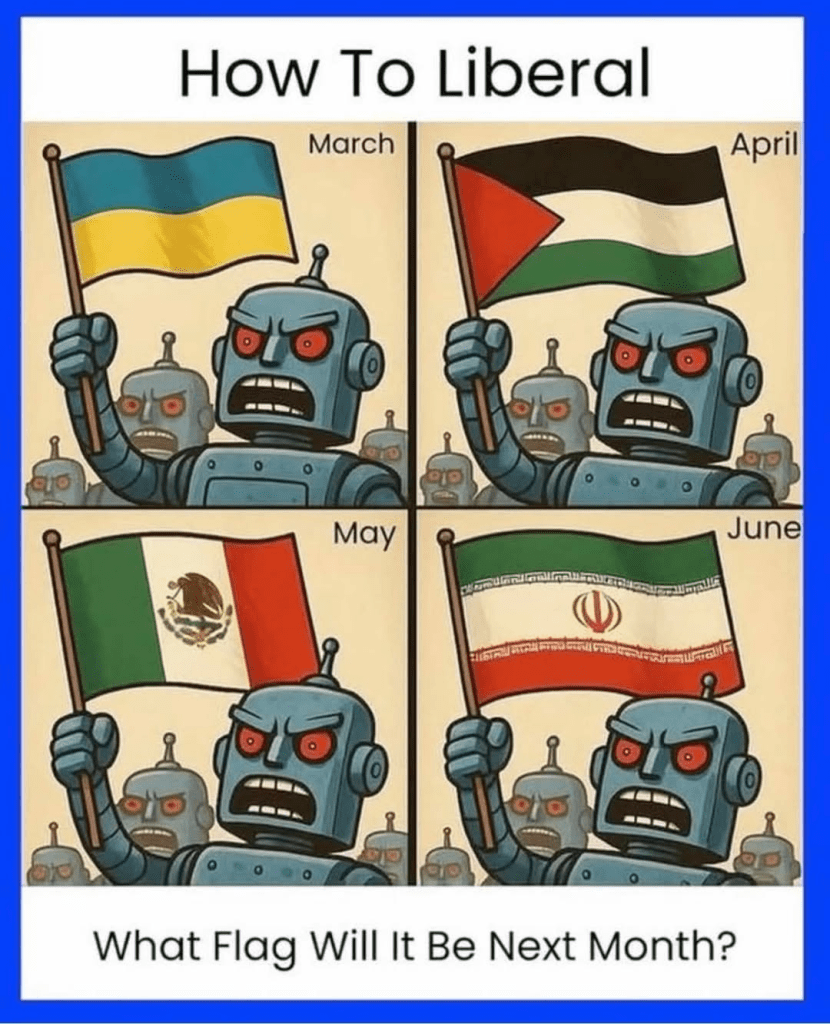
I’ve watched with a mix of amusement and skepticism as liberals leap from one international cause to another, waving a new flag each month with fervor but little consistency. This pattern of “trend-hopping” reflects a lack of deep-rooted principles, prioritizing emotional outbursts over steadfast commitment. Let’s examine this phenomenon through recent examples and ask: What flag will it be next month?
The Monthly Flag Parade
In March, the blue-and-yellow Ukrainian flag dominated social media profiles and street protests. Russia’s invasion sparked outrage, and liberals rallied behind Ukraine, demanding NATO intervention, sanctions, and humanitarian aid. The passion was palpable—celebrities donned sunflower pins, and politicians called for solidarity. Yet, the intensity felt more like a viral campaign than a grounded stance. How many of those flag-wavers could name Ukraine’s capital or explain its geopolitical history before the headlines hit?
By April, attention shifted to the Palestinian flag. As tensions flared in the Israel-Palestine conflict, liberal activists pivoted, championing Palestinian rights and condemning Israel. Campus protests erupted, and hashtags like #FreePalestine trended. The same voices that weeks earlier demanded aid for Ukraine now focused on Gaza, often framing the issues in simplistic, moralistic terms. The speed of this transition raised questions: Was the Ukrainian cause forgotten, or was it just less fashionable?
In May, the Mexican flag surfaced, tied to debates over U.S.-Mexico border policies, immigration reform, or social justice issues south of the border. Liberals voiced support for migrants or critiqued trade policies, but the rhetoric felt recycled—broad, emotional appeals with little focus on practical solutions or Mexico’s complex realities. The pattern was clear: a new cause, a new flag, the same performative zeal.
Come June, the Iranian flag appeared, linked to escalating tensions in the Israel-Iran conflict and the U.S. bombing of Iran’s nuclear facilities. Liberals swiftly condemned the military actions, rallying behind Iran with calls for de-escalation and critiques of U.S. interventionism. Yet, their advocacy often ignored Iran’s role in regional instability or the strategic necessity of curbing its nuclear ambitions. The enthusiasm seemed driven more by anti-war sentiment than by a nuanced understanding of Middle Eastern geopolitics.
The Problem with Flag-Hopping
This flag-waving cycle reveals a troubling trend among liberals: a tendency to latch onto global crises without sustained commitment or intellectual rigor. Each cause is treated as a fleeting fashion statement, discarded when the next crisis grabs the spotlight. This isn’t principled activism—it’s emotional tourism.
This behavior stems from a lack of consistent values. Many prioritize national interests, focusing on issues like border security or economic stability, which anchor a worldview. Liberals, by contrast, seem swayed by whichever cause dominates the news cycle, adopting stances that feel good but lack depth. Their support for Ukraine ignores NATO’s complexities; their Palestine advocacy sidesteps Hamas’s role; their Mexico rhetoric dodges the realities of immigration enforcement; their Iran stance glosses over Tehran’s aggressive posture and nuclear threats.
This isn’t to say others are immune to selective outrage, but the focus tends to be more pragmatic, less driven by global trends. Liberals’ flag-hopping risks diluting genuine activism, turning complex issues into social media props. It also undermines credibility—how can one trust a movement that shifts allegiances so rapidly?
What Flag Next Month?
The question remains: What flag will it be next month? Will it be Sudan, where conflict rages but garners little Western attention? Or perhaps Taiwan, if tensions with China escalate? The liberal flag-waving machine will surely find a new cause to champion, complete with hashtags, rallies, and viral posts. But without a consistent framework, these gestures risk being hollow.
The focus should be on principle over passion. Addressing global issues through a lens of national interest, strategic alliances, and long-term stability—not fleeting emotional highs—is key. Liberals could learn from this. Instead of chasing the next flag, they might consider building a worldview that withstands the test of time.
A Republican Perspective