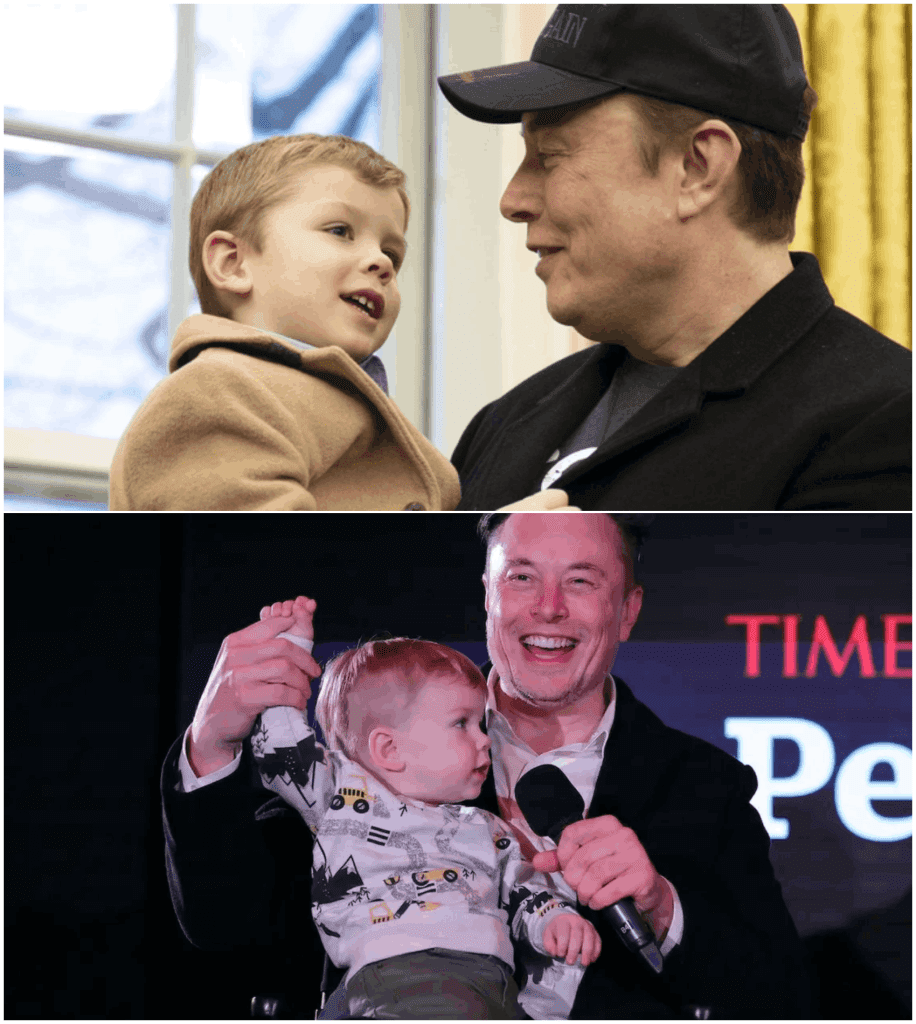
It was a bright spring afternoon at the Austin Convention Center, buzzing like a beehive as 20,000 people crammed into the room. Scientists, world leaders, power-hungry tycoons, and a whole army of professional reporters had gathered to hear Elon Musk pontificate about humanity’s future. But little did anyone know, the “killer” speech of the day wouldn’t come from Elon’s great mind, but from his 5-year-old scion, X Æ A-12, or “X” for short.
Backstage, tiny X was clinging to a piece of paper as if it were the last ticket to Mars. His mom, Grimes, was simultaneously smoothing his messy hair and whispering, “Sweetie, you don’t have to do this. Just wave to the crowd and say hello, okay?”
X shook his head vigorously, his brown eyes as serious as if he’d just discovered a revolutionary instant noodle recipe. “No, Mom. I have to tell them the truth. Kids need to know the truth too!”
Elon Musk, standing nearby, secretly checked his watch. His face was calm, but his hands were trembling uncontrollably, betraying all his feigned composure. He knew exactly what his little terror was about to do. “Are you sure about this, buddy?” Elon quietly asked, his voice sounding like he was trying to convince a terrorist to drop his weapon. “Once you say those words, everything will change—for our family, for the whole world!”
X nodded decisively. At just 5 years old, he already understood that some truths were far too important to keep hidden. Clearly, the apple doesn’t fall far from the tree… or the genius gene.
The MC’s voice echoed through the convention center. “Ladies and gentlemen, today we have a very special guest! Please give a warm welcome to Elon Musk’s son, X Æ A-12, to the stage!”
The crowd clapped politely, eyes sparkling with anticipation for a “cute as a button” moment—a shy wave, maybe a simple “I love my daddy.” But what X was about to say was enough to make the whole world do a double-take.
The room suddenly fell silent as X walked onto the stage, his tiny figure swallowed by the towering microphone. A flustered technician fumbled to adjust the mic down to his height. X looked out at the sea of faces: scientists with furrowed brows, politicians with strained expressions, reporters with glittering eyes, and millions more glued to their online streams. He took a deep breath, clutching the paper in his hand.
“Hello, everyone,” he began, his small voice clear and steady. “My name is X, and I want to tell you something important about my family.”
The audience smiled. A few people even let out an “aww,” expecting a sweet little fairy tale. But X’s next words wiped the smiles clean off every face.
“My dad has a huge secret,” X said, pausing for dramatic effect. “It’s about why he really wants to go to Mars. It’s not what you think.”
Gasps rippled through the crowd. Elon, watching from the side of the stage, froze. Reporters scrambled to take notes and start live tweets. The atmosphere shifted from curiosity to intense tension.
X continued, his voice growing stronger. “Six months ago, I found something in my dad’s office. It was a folder called ‘Project Phoenix.’ It had pictures of Earth, but they didn’t look right. The ice at the North and South Poles was melting, the oceans had brown spots, and some places that were supposed to be land were underwater.”
The audience sat up straighter, their attention fully locked on the tiny boy.
“I also heard my dad talking to his friends—really important people like Jeff Bezos and Bill Gates,” X said. “They talked about how Earth is getting sick faster than anyone thought. They said there might not be enough time to fix it.”
Murmurs spread through the crowd. Elon’s face turned pale as he watched his son reveal secrets that had been closely guarded by world leaders and scientists.
“They said Mars isn’t just about exploration,” X continued. “It’s a backup plan. A place for people to go when Earth gets too dangerous. But here’s the part that made me really sad. Mars can only hold a few million people. There are billions of people on Earth. So who decides who gets to go?”
The room was now in chaos. Some people were crying, others were shouting questions, and camera flashes popped like lightning. X’s voice cut through the noise.
“Why are adults keeping this a secret?” he asked, his voice trembling with emotion. “Kids live on Earth too. We deserve to know what’s happening to our planet. We deserve to help fix it.”
Elon rushed onto the stage, kneeling beside his son. “X, that’s enough,” he whispered, trying to gently pull him away from the microphone.
But X wasn’t done. He looked out at the audience, his small voice carrying an enormous message. “My dad always says we should work together to solve big problems. So why aren’t we working together to save Earth? Why are we keeping secrets instead of telling the truth?”
For a moment, the entire convention center was silent. Then, slowly, the crowd began to clap. The applause grew louder and louder until it became a standing ovation. People were cheering, crying, and hugging each other.
Elon stood, taking the microphone. His face was a mix of pride, fear, and sheer determination. “My son is right,” he said, his voice steady but emotional. “We’ve been keeping secrets because we thought we were protecting you. But hiding the truth isn’t the answer. Working together is.”
Elon went on to confirm everything X had said: the climate crisis was worse than the public had been told, and Mars was being developed as a backup plan. But he also shared something hopeful.
“We’re not giving up on Earth,” Elon declared. “Right now, scientists and engineers are working on solutions—ways to slow down ice melting, clean the air, and adapt to rising seas. But we need everyone’s help, especially young people. Kids see the world differently. They ask questions we don’t think to ask. They imagine solutions we can’t see. It’s time to let them be part of the conversation.”
The crowd erupted into cheers again. For the first time in years, the conversation about climate change wasn’t just about fear—it was about hope.
In the weeks that followed, X’s speech went viral, viewed by billions of people around the world. Kids from every continent started making their own videos, sharing ideas for how to help save the planet. A 10-year-old in Brazil planted trees to absorb carbon dioxide. A 12-year-old in Kenya invented a rainwater collection system for drought-prone areas. A 15-year-old in Japan designed floating homes for families affected by rising sea levels.
World leaders were forced to respond. Nations that had been hesitant to act on climate change began sharing data and funding youth-led initiatives. Billionaires pledged billions of dollars to support climate solutions designed by kids.
Elon kept his promise, launching a new program called the Global Youth Climate Council. It gave young people a platform to share their ideas and work with scientists, engineers, and policymakers. X was named the council’s first ambassador.
One year later, X stood on the same stage at the Austin Convention Center, now six years old and more confident than ever. This time, he wasn’t just speaking to adults—he was speaking to kids from around the world who had joined the movement.
“Last year, I told a scary truth,” X began. “But today, I want to tell you something hopeful. The world is listening to us now. Adults and kids are working together to save Earth and explore the stars. And when we work together, we can do anything.”
The audience erupted into cheers as X smiled. He had gone from a curious little boy to a global symbol of courage and hope. And he had proven that even the smallest voices could change the world.