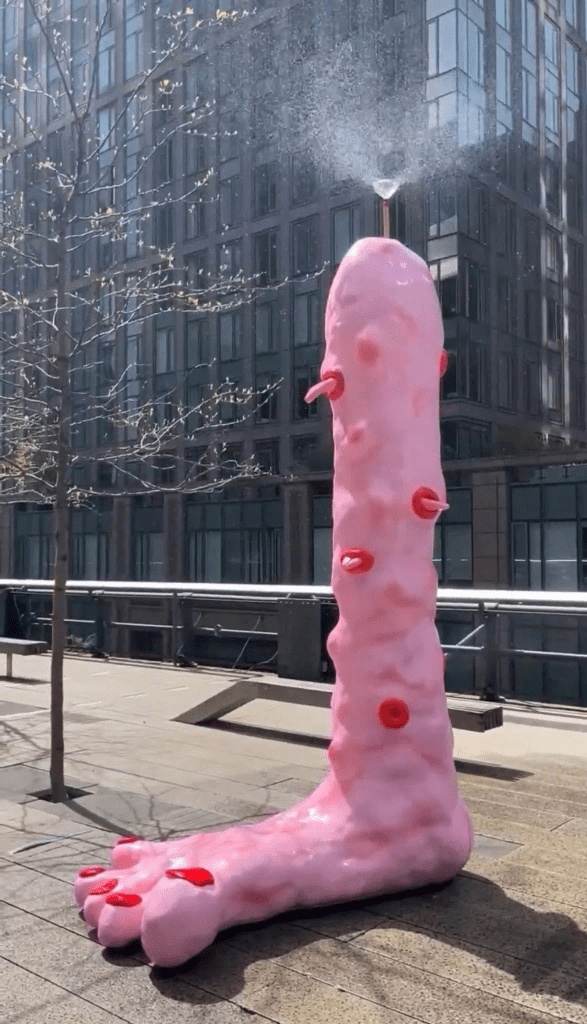
In the sprawling metropolis of New York City, a new public art installation has recently ignited a fervent debate, drawing sharp criticism and raising questions about the allocation of public funds. Against a backdrop of persistent urban challenges—including a discernible rise in crime rates, an escalating homelessness crisis, and palpable economic uncertainties—city officials proudly unveiled a striking, albeit perplexing, 10-foot-tall “Foot Fountain.” This monumental pink sculpture, conceived by Argentine artist Mika Rottenberg, features water dramatically spraying from its uppermost extremity, an artistic choice that has left many residents and observers scratching their heads.
The official narrative accompanying this unique piece posits it as a symbol of “peace and love.” However, for a significant segment of the populace, this explanation rings hollow, bordering on the absurd. The dissonance between the declared artistic intent and the pressing realities faced by everyday New Yorkers has become a focal point of public discourse. Is it genuinely a testament to lofty ideals, or merely an extravagant distraction from more fundamental civic responsibilities?
What has often been overlooked, or perhaps deliberately understated, in the mainstream media’s portrayal of this unveiling are several critical concerns. Foremost among these is the undeniable fact that substantial taxpayer dollars have been channeled into commissioning and installing this particular art piece. In a city where budgetary constraints are frequently cited in discussions about essential services, the decision to invest in such a distinctive, and to some, bizarre, public sculpture naturally invites scrutiny. Citizens are left to ponder the opportunity cost: could these funds have been better utilized to address the very issues that plague their daily lives?
Furthermore, the juxtaposed reality of unsafe streets with the unveiling of a 10-foot pink toe has become a potent symbol for critics. While concerns about public safety and the prevalence of crime remain paramount for many New Yorkers, the city’s apparent willingness to fund a project of this nature strikes a discordant note. It prompts an uncomfortable question: what message does this send to a populace grappling with genuine anxieties about their personal security and the well-being of their communities?
This situation, for many, encapsulates a troubling convergence of contemporary progressive ideologies and what are perceived as the self-indulgent ambitions of an elite cultural class. The “woke politics” often championed by segments of the city’s leadership, when translated into projects like the “Foot Fountain,” are seen not as forward-thinking initiatives but as vanity projects detached from the practical needs and concerns of the average citizen. It suggests a prioritisation of abstract artistic expression over tangible improvements in quality of life.
To categorize this development as “creativity” would be, in the eyes of many, a misnomer. Instead, it is increasingly being labeled as a manifestation of “clown world priorities”—a term that vividly conveys a sense of civic governance gone awry, where logic and common sense appear to have been abandoned in favor of the eccentric and the ostentatious.
The aspirations of authentic New Yorkers, the hardworking individuals who form the backbone of this vibrant city, are remarkably straightforward and pragmatic. They yearn for safe streets where their children can play without fear, and where they can commute without apprehension. They desire clean neighborhoods, free from the blight of litter and urban decay, fostering a sense of pride and community. Above all, they demand fiscal responsibility from their elected officials—a commitment to prudent spending, efficient resource allocation, and a focus on essential services that directly benefit the populace.
What they emphatically do not desire are peculiar monuments to nothingness. They seek tangible solutions to real problems, not abstract artistic statements that fail to resonate with their everyday struggles. The “Foot Fountain” has thus become more than just a piece of art; it has become a lightning rod for a broader conversation about governance, priorities, and the true meaning of progress in one of the world’s most iconic cities. This is not merely an artistic critique; it is a profound questioning of the direction in which New York City is being led.