The declaration, “The world’s richest man is killing the world’s poorest children,” purportedly uttered by Mr. Bill Gates, stands as a stark indictment. However, upon meticulous investigation, no credible evidence substantiates that Mr. Gates made such a pronouncement. This absence of verification casts doubt upon the authenticity of the statement and suggests that it may serve as a rhetorical instrument, crafted to illuminate the chasm between the world’s most affluent individuals and its most destitute populations.
The phrase “the world’s richest man” likely alludes to figures such as Mr. Elon Musk or Mr. Jeff Bezos, who have frequently occupied the pinnacle of global wealth rankings in recent years. As of May 2025, Mr. Musk, through his stewardship of enterprises such as Tesla and SpaceX, is often recognized as the wealthiest individual, with a fortune estimated in the hundreds of billions of dollars. Mr. Gates, though no longer the foremost in wealth, remains a towering figure, both for his financial stature and his enduring commitment to philanthropy through the Bill & Melinda Gates Foundation.
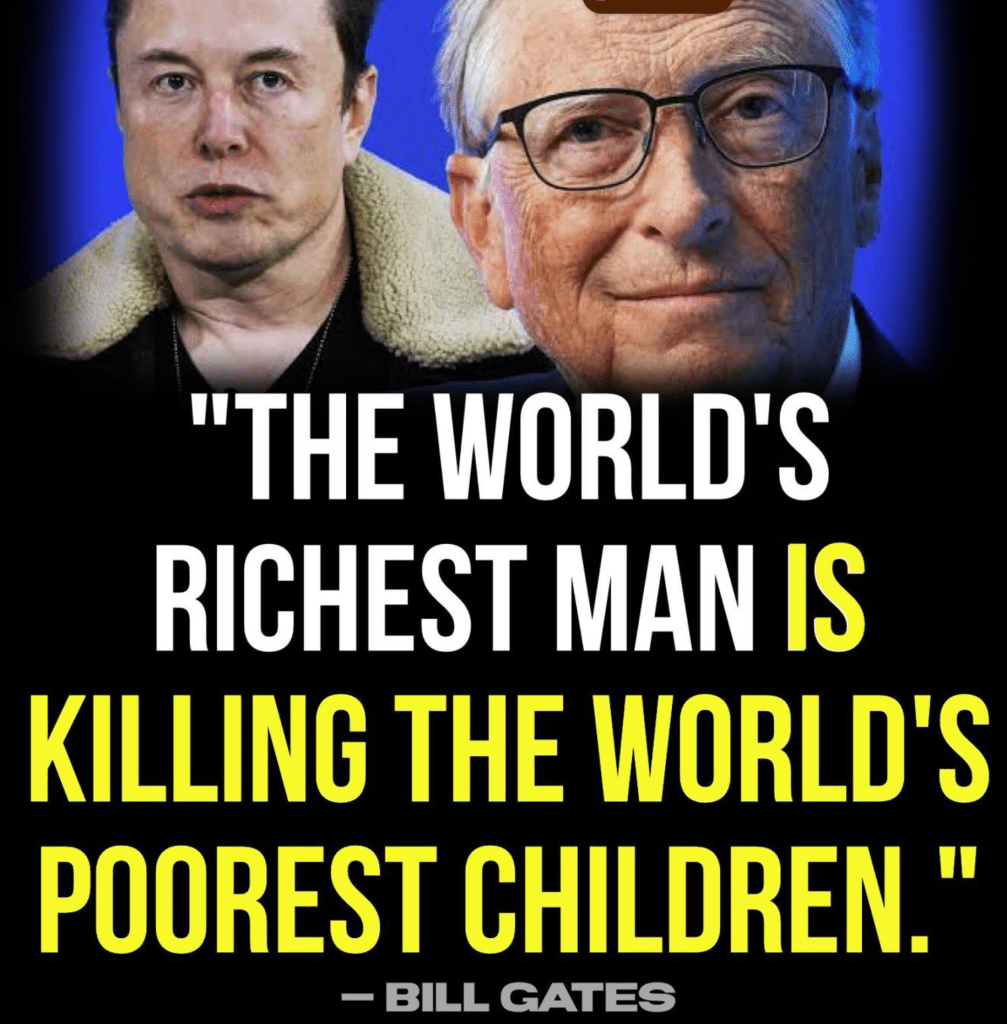
The latter segment of the statement—”killing the world’s poorest children”—is an assertion of grave import, necessitating careful scrutiny. The mortality of children in impoverished regions is a multifaceted tragedy, precipitated by systemic deficiencies such as inadequate healthcare, malnutrition, armed conflict, and the escalating impacts of climate change. To attribute this profound suffering to the actions of a single individual, even one of considerable influence, oversimplifies a deeply complex issue. Nevertheless, the statement may be interpreted as a metaphorical critique, intended to underscore how the concentration of wealth and the policies of the elite may inadvertently exacerbate global inequities.
The Philanthropic Endeavors of Mr. Bill Gates
Mr. Bill Gates, through the establishment of the Bill & Melinda Gates Foundation in 2000, has emerged as a preeminent figure in the realm of global health and poverty alleviation. The foundation has allocated billions of dollars to initiatives aimed at eradicating scourges such as malaria, polio, and tuberculosis, enhancing maternal and child health, and broadening access to education and technological innovation. By some accounts, the foundation’s endeavors have preserved millions of lives, particularly in regions where child mortality rates have historically been alarmingly elevated.
Among the foundation’s most laudable efforts is its commitment to the development and dissemination of vaccines. Mr. Gates has been an ardent proponent of immunization, channeling substantial resources into research and distribution networks to ensure that children in the most impoverished regions receive life-saving inoculations. Through partnerships such as that with Gavi, the Vaccine Alliance, the foundation has facilitated the immunization of hundreds of millions of children against lethal diseases, including measles and diphtheria. These initiatives have contributed to a marked decline in global child mortality, which has decreased from 12.5 million annually in 1990 to approximately 5 million in recent years.
Yet, the foundation’s endeavors have not been immune to criticism. Detractors contend that Mr. Gates wields an inordinate degree of influence over global health policy, a role they deem disproportionate for an unelected individual. Furthermore, some have scrutinized the foundation’s investments in sectors such as agriculture and pharmaceuticals, asserting that these may prioritize corporate interests over the welfare of the indigent. For instance, the foundation’s advocacy for genetically modified crops has elicited contention, with critics arguing that such practices undermine traditional agricultural methods and foster dependency on multinational conglomerates.
The Peril of Wealth Disparity
The image disseminated by Occupy Democrats appears to encapsulate a broader critique of wealth disparity and its ramifications for the most vulnerable populations. The world’s most affluent individuals, including Mr. Musk, Mr. Bezos, and Mr. Gates, command resources of an unprecedented magnitude. Reports from organizations such as Oxfam indicate that the wealthiest 1% of the global populace controls nearly half of the world’s wealth, while billions languish in abject poverty, subsisting on less than two dollars per day. This disparity bears profound consequences for child welfare, as poverty remains a principal driver of child mortality.
Children in the most impoverished regions confront a litany of adversities that precipitate elevated mortality rates. Malnutrition, for instance, constitutes a primary cause of death among children under the age of five, accounting for nearly half of all such fatalities globally. The absence of access to potable water and adequate sanitation engenders diseases such as diarrhea, which claims the lives of hundreds of thousands of children annually. In regions beset by conflict, children endure disproportionate suffering, facing violence, displacement, and the deprivation of essential medical care. The specter of climate change further aggravates these challenges, as extreme weather events and rising temperatures disproportionately afflict the most destitute communities.
The question arises: Are individuals such as Mr. Musk or Mr. Gates directly culpable for these systemic afflictions? On one hand, their wealth is a product of a global economic order that often prioritizes profit over societal well-being. Enterprises such as Tesla and Amazon have faced censure for labor practices that exploit workers, both domestically and internationally. On the other hand, figures such as Mr. Gates have devoted substantial portions of their fortunes to ameliorating these very challenges, funding initiatives that directly benefit the world’s most disadvantaged children.
A Systemic Affliction, Not an Individual Failing
While the image singles out “the world’s richest man,” the reality is that child mortality constitutes a systemic affliction, not the fault of any singular entity. Governments, corporations, and international bodies all bear responsibility for either perpetuating or alleviating the conditions that lead to the deaths of children. For instance, many low-income nations grapple with crippling debt burdens that constrain their capacity to invest in healthcare and education. Structural adjustment programs, often mandated by institutions such as the International Monetary Fund, have compelled these nations to curtail social expenditures, thereby exacerbating poverty and child mortality.
Concurrently, the ultra-wealthy possess a unique capacity—and, some would argue, a moral imperative—to address these systemic challenges. Individuals such as Mr. Gates have demonstrated that private wealth can be harnessed for the public good, yet their efforts cannot supplant the need for comprehensive systemic reform. Critics assert that philanthropy, while commendable, often functions as a palliative measure, addressing symptoms rather than root causes. For example, while the Gates Foundation has preserved countless lives through its vaccination programs, it has been less vocal in confronting the structural inequalities that perpetuate poverty on a global scale.
A Path Forward: A Call for Deliberation and Resolve
The image disseminated by Occupy Democrats, though contentious, has fulfilled a vital purpose: it has catalyzed a critical discourse on wealth, power, and moral responsibility. Rather than castigating individuals such as Mr. Gates or Mr. Musk, society must seize this moment to scrutinize the broader systems that permit extreme wealth and extreme poverty to coexist. What measures can be undertaken to ensure that the world’s most destitute children are afforded the opportunity to lead healthy, fulfilling lives?
First, governmental authorities must prioritize policies that address the fundamental causes of child mortality. This necessitates robust investments in universal healthcare, enhanced access to education, and the establishment of social safety nets to elevate families from poverty. Debt relief for low-income nations could liberate resources for these essential initiatives. Moreover, international collaboration is indispensable in confronting global challenges such as climate change, which disproportionately impacts the most vulnerable.
Second, the ultra-wealthy must assume a more proactive role in advocating for systemic reform. While philanthropy is a noble pursuit, billionaires wield the influence to champion policies that address inequality at its core. This might encompass support for progressive taxation, advocacy for equitable labor practices, and investment in sustainable development projects that empower local communities.
Finally, public awareness and advocacy remain paramount. The image, despite its provocative tone, has illuminated an issue often relegated to the periphery of mainstream discourse. Through measured and constructive dialogue, society can hold both individuals and systems accountable while striving toward a more just and equitable world.
Conclusion
The statement attributed to Mr. Bill Gates—”The world’s richest man is killing the world’s poorest children”—may not be a verbatim utterance, yet it encapsulates a sobering truth about global inequality. While Mr. Gates has devoted much of his fortune to advancing child welfare, the systemic challenges that contribute to child mortality persist unabated. The image from Occupy Democrats serves as a poignant reminder that wealth and influence carry with them a profound responsibility. As we chart the path forward, let us transform this moment of contention into a catalyst for meaningful action, ensuring that the world’s most vulnerable children are not forsaken in a world of abundance.