The statement, “Only in America does the Vice President sashay to fancy climate conferences in private jets, then shrug and say clean water for Flint is ‘just too pricey,’” is a satirical indictment of perceived hypocrisy within the highest echelons of American leadership. While the Vice President, Kamala Harris, has not explicitly made such a statement, the sentiment reflects a broader public disillusionment with leaders who champion global causes while domestic crises languish. The imagery of “sashaying to fancy climate conferences in private jets” symbolizes a disconnect between the elite and the everyday struggles of citizens, while the reference to Flint underscores a failure to address a decade-long environmental disaster that continues to harm a predominantly low-income, Black community.
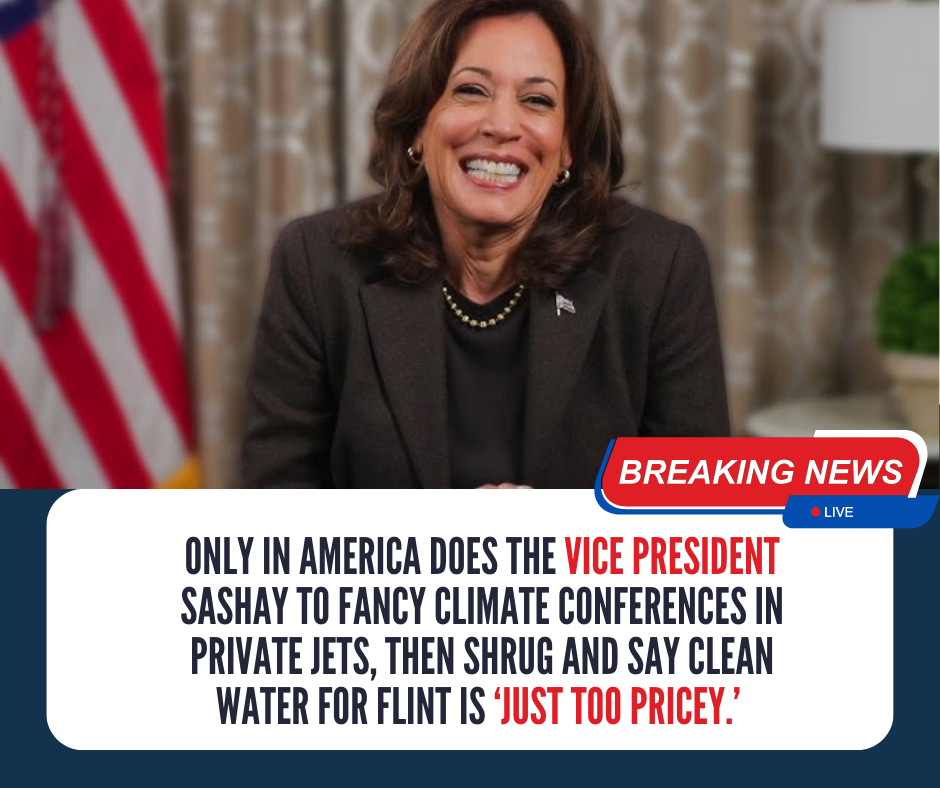
The phrase “only in America” highlights a perceived irony: the United States, a nation of immense wealth and global influence, struggles to provide basic necessities like clean water to its citizens while its leaders attend high-profile international summits. The Flint water crisis, which began in 2014, remains a stark reminder of systemic neglect, and the critique suggests that resources allocated to symbolic gestures—such as attending climate conferences—could be better directed toward resolving pressing domestic issues. This juxtaposition compels a deeper examination of leadership priorities, environmental justice, and the role of privilege in perpetuating inequality.
The Flint Water Crisis: A Persistent Injustice
The Flint water crisis is one of the most egregious examples of environmental injustice in recent American history. In April 2014, the city of Flint, Michigan, switched its water source from the Detroit Water and Sewerage Department to the Flint River as a cost-saving measure. This decision, made by state-appointed emergency managers, was implemented without proper corrosion control, leading to the leaching of lead and other contaminants into the water supply. The result was catastrophic: thousands of residents, including children, were exposed to toxic levels of lead, causing irreversible health impacts such as developmental delays, cognitive impairments, and behavioral issues.
Despite the crisis gaining national attention by 2016, the response has been woefully inadequate. As of May 2025, many Flint residents still lack access to reliably safe drinking water, and the city’s aging infrastructure remains a significant barrier to a full resolution. Lead service lines, which connect water mains to homes, have been replaced at a sluggish pace, with funding shortages and bureaucratic delays hampering progress. The health consequences continue to unfold, with studies linking the crisis to increased rates of miscarriages, Legionnaires’ disease outbreaks, and long-term psychological trauma among residents.
The Flint crisis is not merely a failure of infrastructure; it is a failure of governance and accountability. The decision to switch water sources was driven by financial considerations, prioritizing cost over the well-being of a predominantly low-income, African American community. Subsequent investigations revealed a pattern of negligence and obfuscation by state and local officials, who downplayed the severity of the contamination and dismissed residents’ concerns. The crisis has become a symbol of systemic racism and classism, exposing how marginalized communities are disproportionately burdened by environmental hazards.
Leadership and the Climate Conference Critique
The satirical statement targets Vice President Kamala Harris, who has been a vocal advocate for climate action and environmental justice. Since taking office in 2021, Harris has attended numerous international climate summits, such as the COP conferences, to represent the U.S. in global efforts to combat climate change. These summits are often high-profile events, attended by world leaders and accompanied by significant media coverage. The use of private jets for such travel, while not uncommon for officials of her stature, has drawn scrutiny for its environmental impact, particularly given the focus on climate change.
The critique of Harris “sashaying” to these conferences while Flint remains unresolved reflects a broader frustration with symbolic gestures that fail to address immediate, tangible crises. Climate change is undoubtedly a pressing global issue, with far-reaching implications for future generations. However, for the residents of Flint, the lack of clean water is an urgent, daily reality that has persisted for over a decade. The statement suggests that the resources—both financial and political—expended on international summits could be redirected to resolve domestic issues like Flint, where the need is immediate and the stakes are dire.
It is worth noting that Harris has spoken about environmental justice throughout her tenure, often highlighting the disproportionate impact of pollution and climate change on marginalized communities. In 2021, she visited Flint as part of the Biden administration’s efforts to address infrastructure challenges, announcing federal funding to replace lead pipes nationwide. However, critics argue that these efforts have been insufficient, with Flint residents still facing delays and inadequate support. The satirical statement, while hyperbolic, underscores the perception that leadership has prioritized global optics over local action, leaving communities like Flint to fend for themselves.
The Cost of Clean Water: A Question of Priorities
The latter part of the statement—that clean water for Flint is “just too pricey”—is a pointed critique of how resources are allocated in the U.S. The cost of fully resolving the Flint water crisis, including replacing all lead service lines, upgrading infrastructure, and providing long-term health support for residents, has been estimated in the hundreds of millions of dollars. While this is a significant sum, it pales in comparison to other government expenditures, such as military budgets, corporate tax breaks, or even the cost of high-profile international trips.
For example, the U.S. government spends billions annually on defense, with the 2025 defense budget exceeding $850 billion. The cost of a single private jet trip for a high-ranking official, including security and logistics, can run into the hundreds of thousands of dollars per trip. While these expenditures serve different purposes, the juxtaposition highlights a stark reality: the resources to address Flint’s crisis exist, but the political will to prioritize it has been lacking. The statement’s sarcasm underscores the absurdity of deeming clean water “too pricey” in a nation with the wealth and capacity to address such a fundamental need.
Moreover, the Flint crisis is not an isolated issue. Across the U.S., thousands of communities—particularly those that are low-income or predominantly minority—face similar challenges with lead-contaminated water, aging infrastructure, and environmental pollution. The Biden administration’s Infrastructure Investment and Jobs Act of 2021 allocated $15 billion to replace lead pipes nationwide, but experts estimate that the total cost could be as high as $60 billion. This gap between funding and need underscores the systemic nature of the problem and the urgent need for a comprehensive, equity-driven approach.
A Path Forward: Accountability and Environmental Justice
The satirical statement, while sharp, has ignited a critical conversation about leadership, privilege, and environmental justice. Rather than focusing solely on the actions of one individual, this moment offers an opportunity to address the systemic failures that allow crises like Flint to persist. What steps can be taken to ensure that the basic needs of all citizens are met, and that leadership prioritizes the most vulnerable?
First, there must be a renewed commitment to resolving the Flint water crisis. This includes expediting the replacement of lead service lines, ensuring that all residents have access to clean water, and providing comprehensive health support for those affected by the contamination. Federal and state governments must allocate sufficient funding and hold officials accountable for delays, ensuring that the community’s needs are met with urgency and transparency.
Second, leadership must demonstrate a genuine commitment to environmental justice. This means prioritizing the needs of marginalized communities in policy decisions, from infrastructure investments to climate adaptation measures. High-profile climate summits are important, but they must be accompanied by tangible action at home. Reducing the carbon footprint of official travel, such as opting for more sustainable transportation methods, would also align with the climate goals leaders espouse on the global stage.
Finally, public engagement and advocacy are essential. The residents of Flint have been tireless in their fight for justice, raising awareness and demanding accountability. Their voices must be amplified, and their experiences must inform policy at every level. Grassroots movements, community organizing, and civic participation can hold leaders accountable and drive systemic change, ensuring that no community is left behind.