The statement, “Only in America could a billionaire make us pay for his golf weekends and tell us we can’t have food, health, science, or art,” encapsulates a profound critique of American governance and societal values. While the image does not explicitly name the individual in question, it is widely understood to reference a former high-ranking official known for both his immense personal wealth and frequent golfing excursions during his tenure. The accusation is twofold: first, that public funds were allegedly used to subsidize personal leisure activities of a billionaire; second, that such an individual could simultaneously advocate for policies that deprive citizens of essential services such as food security, healthcare, scientific advancement, and cultural enrichment.
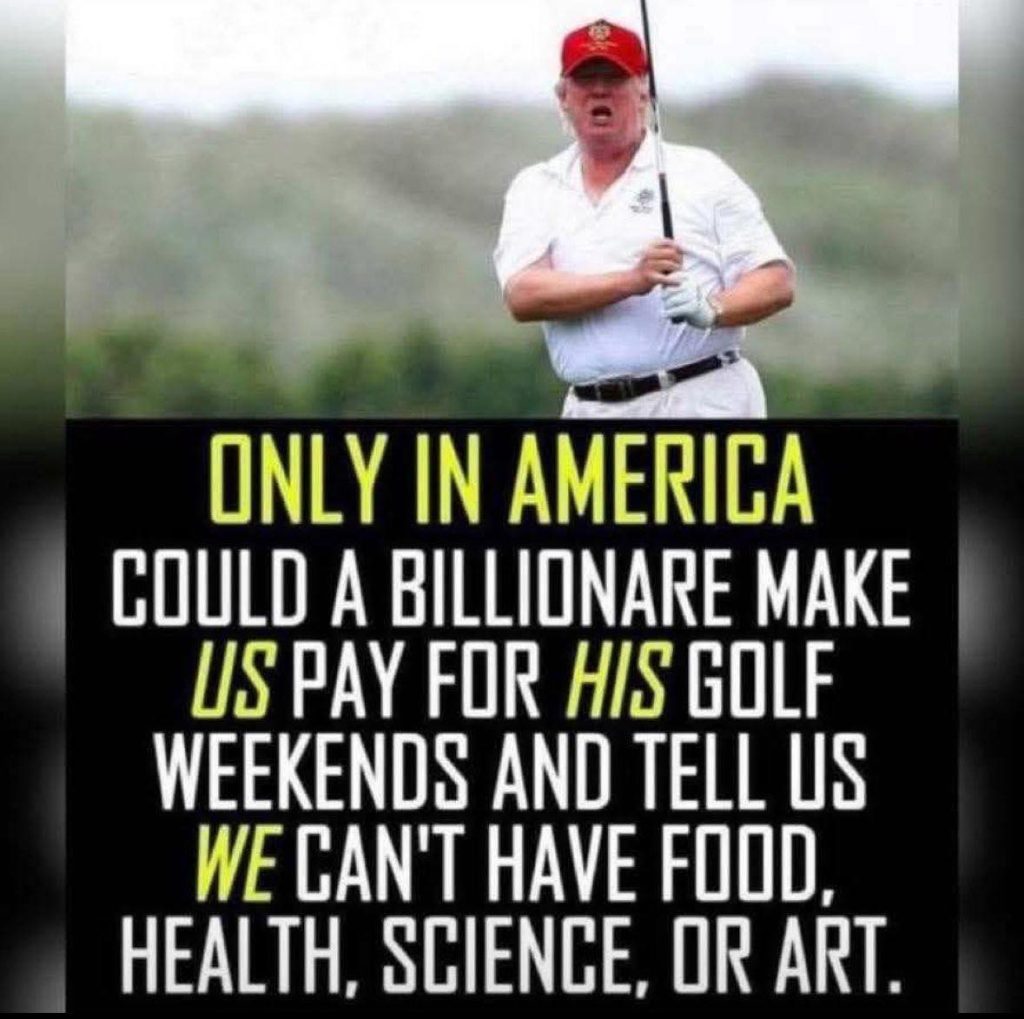
The phrase “only in America” underscores a perceived uniqueness to this phenomenon, suggesting that the United States, despite its vast wealth and democratic ideals, harbors systemic flaws that permit such disparities to persist. The mention of “golf weekends” symbolizes the ostentatious privilege of the elite, while the denial of “food, health, science, or art” represents the fundamental needs and aspirations of the broader populace. This juxtaposition compels us to confront uncomfortable questions about the allocation of resources, the influence of wealth in politics, and the erosion of societal values that prioritize the common good.
The Context of Wealth and Political Influence
The United States has long been heralded as a land of opportunity, where individuals can amass great wealth through ingenuity and determination. However, this narrative of meritocracy is increasingly overshadowed by the reality of wealth inequality. As of May 2025, the richest 1% of Americans control a disproportionate share of the nation’s wealth, with billionaires such as Elon Musk, Jeff Bezos, and others commanding fortunes in the hundreds of billions. This concentration of wealth is not merely a statistic; it translates into significant political influence, as affluent individuals and corporations wield the power to shape policy through campaign contributions, lobbying efforts, and media influence.
The individual referenced in the image, a billionaire who held a prominent political office, exemplifies this nexus of wealth and power. During his tenure, reports emerged that his frequent golf outings—often at his own properties—incurred substantial costs to taxpayers. Estimates suggest that these trips, which included security details and logistical support, amounted to millions of dollars over the course of his term. Critics argue that such expenditures, borne by the public, reflect a misuse of resources at a time when many Americans struggle to meet their basic needs.
Concurrently, the same administration faced criticism for policies perceived to undermine access to essential services. Budget proposals during this period often sought to reduce funding for programs such as the Supplemental Nutrition Assistance Program (SNAP), which provides food assistance to low-income families. Efforts to dismantle or limit the Affordable Care Act threatened to reduce healthcare access for millions. Federal investments in scientific research, particularly in areas like climate change and public health, were curtailed, while funding for the arts and humanities faced perennial threats of elimination. These policy decisions, juxtaposed with the image of a billionaire enjoying lavish golf weekends, fueled public outrage and gave rise to the sentiment encapsulated in the viral image.
The Plight of the Underserved: Food, Health, Science, and Art
The denial of “food, health, science, or art” as articulated in the image represents a profound betrayal of societal values. These elements are not mere luxuries; they are foundational to human dignity, progress, and well-being. In the United States, a nation of immense wealth and resources, the persistence of deprivation in these areas is a moral failing that demands redress.
Food Security: Hunger remains a pressing issue in America, with millions of families facing food insecurity. According to data from recent years, approximately 10% of U.S. households struggle to access adequate nutrition, a figure that disproportionately affects children, minorities, and rural communities. Cuts to programs like SNAP exacerbate this crisis, leaving families to choose between food and other necessities such as rent or medical care. The irony of public funds being allocated to subsidize a billionaire’s leisure while food assistance programs face reductions is a stark illustration of misplaced priorities.
Healthcare: Access to healthcare is a fundamental right, yet millions of Americans remain uninsured or underinsured. Efforts to undermine the Affordable Care Act, coupled with rising healthcare costs, have left many without access to essential medical services. The COVID-19 pandemic further exposed these vulnerabilities, highlighting the need for robust public health infrastructure. Policies that prioritize the financial interests of the elite over the health of the populace undermine the very principles upon which a just society is built.
Science: Scientific advancement has long been a cornerstone of American innovation, driving progress in medicine, technology, and environmental sustainability. However, reductions in federal funding for research institutions, such as the National Institutes of Health and the National Science Foundation, threaten to stifle this progress. At a time when global challenges like climate change and pandemics demand rigorous scientific inquiry, the deprioritization of science in favor of personal indulgences is a disservice to future generations.
Art: The arts and humanities enrich society, fostering creativity, cultural understanding, and emotional well-being. Yet, funding for the National Endowment for the Arts and the National Endowment for the Humanities has been repeatedly targeted for cuts. These reductions limit access to cultural programs, particularly in underserved communities, depriving individuals of the transformative power of art. The arts are not a frivolous expenditure; they are a vital component of a thriving society.
Systemic Failures: Beyond Individual Actions
While the image focuses on the actions of a single individual, the issues it raises are symptomatic of broader systemic failures. The United States operates within a political and economic framework that often prioritizes the interests of the wealthy over those of the general populace. Campaign finance laws allow affluent individuals and corporations to exert disproportionate influence over elected officials, resulting in policies that perpetuate inequality. Tax structures that favor the rich, coupled with loopholes that enable tax avoidance, further exacerbate the wealth gap.
Moreover, the culture of political privilege in America often insulates leaders from accountability. The use of public funds for personal gain, whether through golf trips or other means, reflects a broader erosion of ethical governance. This lack of accountability undermines public trust in institutions and perpetuates a cycle of disillusionment among citizens who feel their needs are ignored.
The phrase “only in America” also invites reflection on whether such disparities are indeed unique to the United States. While other nations grapple with inequality, the U.S. stands out for its juxtaposition of extreme wealth with systemic deprivation. The absence of universal healthcare, robust social safety nets, and equitable education systems—features common in other developed nations—amplifies the impact of these disparities. Addressing these issues requires a fundamental reevaluation of societal priorities and a commitment to systemic reform.
A Path Forward: Advocating for Equity and Accountability
The viral image, though provocative, has succeeded in igniting a critical discourse on privilege, power, and societal values. Rather than fixating solely on the actions of one individual, society must seize this moment to address the systemic inequities that permit such disparities to persist. What measures can be undertaken to ensure that the needs of all citizens—particularly the most vulnerable—are prioritized over the indulgences of the elite?
First, governmental authorities must recommit to policies that promote equity and access to essential services. This includes safeguarding and expanding programs like SNAP to ensure food security for all families. Strengthening the Affordable Care Act and pursuing universal healthcare initiatives would provide a safety net for those in need. Increased funding for scientific research and the arts would foster innovation and cultural enrichment, benefiting society as a whole.
Second, mechanisms for accountability must be strengthened to prevent the misuse of public resources. Stricter oversight of government expenditures, coupled with transparency in how public funds are allocated, would restore trust in institutions. Campaign finance reform is also essential to reduce the influence of wealth in politics, ensuring that elected officials represent the interests of their constituents rather than those of wealthy donors.
Finally, public engagement and advocacy are paramount. The viral image has brought attention to issues that are often overlooked in mainstream discourse. By fostering constructive dialogue, citizens can hold leaders accountable and advocate for policies that prioritize the common good. Grassroots movements, community organizing, and civic participation are powerful tools for effecting change.