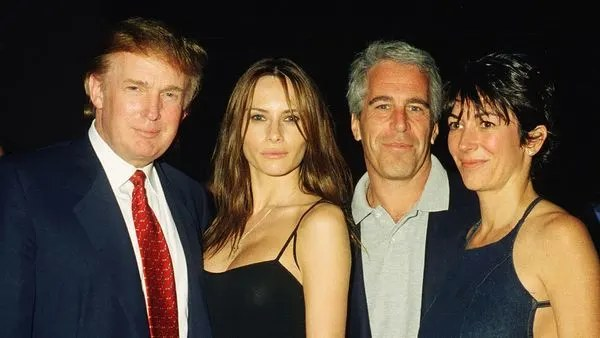
From left, American real estate developer Donald Trump and his girlfriend (and future wife), former model Melania Knauss, financier (and future convicted sex offender) Jeffrey Epstein, and British socialite Ghislaine Maxwell pose together at the Mar-a-Lago club, Palm Beach, Florida, February 12, 2000. (Photo by Davidoff Studios/Getty Images)
In an era defined by intense political polarization, few figures escape the relentless glare of public and congressional scrutiny. The recent congressional hearing, which saw Democratic Representative Jasmine Crockett challenge the foundational legitimacy of former First Lady Melania Trump’s immigration path, serves as a stark illustration of how personal narratives can become battlegrounds in the broader political arena. At the heart of the debate lies the EB-1 visa, colloquially known as the “Einstein visa,” a designation reserved for individuals demonstrating “extraordinary ability”—a term now subject to varied interpretations by political factions.
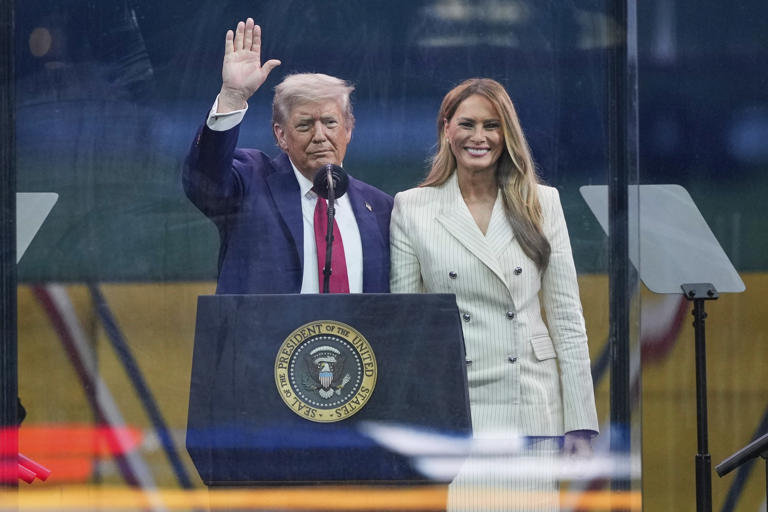
The essence of Crockett’s questioning centered on the criteria for such a prestigious visa, typically associated with Nobel laureates, Olympic medalists, or those with profound impact in science, arts, education, business, or athletics. The implication, clearly articulated, was that Mrs. Trump’s professional background as a model did not align with these elevated standards. This line of inquiry, while framed as an oversight, prompts a deeper examination into the nature of “extraordinary ability” itself. Is it solely confined to academic or athletic prowess, or can it encompass the resilience, adaptability, and unique professional trajectory that defines many successful individuals, including those who navigate the highly competitive world of fashion and public life? The very public success she achieved later, particularly her role as First Lady, undeniably placed her on a national and international stage, a level of acclaim few ever reach.
The timing of these renewed inquiries is particularly salient. They emerge amidst a fervent national debate on immigration, spearheaded by a former president whose administration initiated robust measures to fortify national borders and streamline legal entry processes. Critics are quick to highlight a perceived incongruity between these policies and Mrs. Trump’s own immigration journey. However, proponents argue that her case, having navigated the legal framework to obtain citizenship, stands in stark contrast to the challenges posed by illegal immigration. Her path, they contend, represents the very legal and orderly process that many Americans advocate for, demonstrating that the system, when followed, can lead to the realization of the American Dream.

(
Furthermore, the discussion veered into historical associations, particularly an image from 2000 featuring Mrs. Trump alongside figures who later faced public condemnation. This reintroduction of past encounters, while factually verifiable, raises questions about the motives behind its resurgence in a contemporary political context. Is it a genuine attempt to uncover previously hidden information, or a calculated maneuver to employ guilt-by-association tactics? Such tactics, often seen in high-stakes political skirmishes, aim to cast shadows on character rather than focus on substantive policy discussions.
From left, American real estate developer Donald Trump and his girlfriend (and future wife), former model Melania Knauss, financier (and future convicted sex offender) Jeffrey Epstein, and British socialite Ghislaine Maxwell pose together at the Mar-a-Lago club, Palm Beach, Florida, February 12, 2000. (Photo by Davidoff Studios/Getty Images)
Interestingly, the hearing also featured a lighthearted, yet insightful, intervention from Alex Nowrasteh of the Cato Institute. His quip—that successfully marrying Donald Trump could itself be considered an “extraordinary achievement”—served to inject a moment of levity into a tense exchange, while subtly redirecting the conversation towards the unique challenges and public demands faced by individuals in such high-profile relationships. This perspective underscores that “extraordinary ability” might also encompass personal fortitude and the capacity to thrive under immense public pressure, attributes demonstrably required of a First Lady.
Ultimately, the questioning of Melania Trump’s visa serves as a microcosm of the larger ideological battles shaping America. It forces a critical look at how legal immigration processes are perceived, how success is defined, and the lengths to which political adversaries will go to score rhetorical points. For supporters, this episode simply reaffirms a deep-seated distrust of partisan attacks, while for critics, it highlights perceived inconsistencies in public figures’ narratives. The ongoing discourse ensures that the intersection of personal histories, public roles, and political maneuvering will remain a fertile ground for debate, reflecting the dynamic and often contentious nature of American democracy.