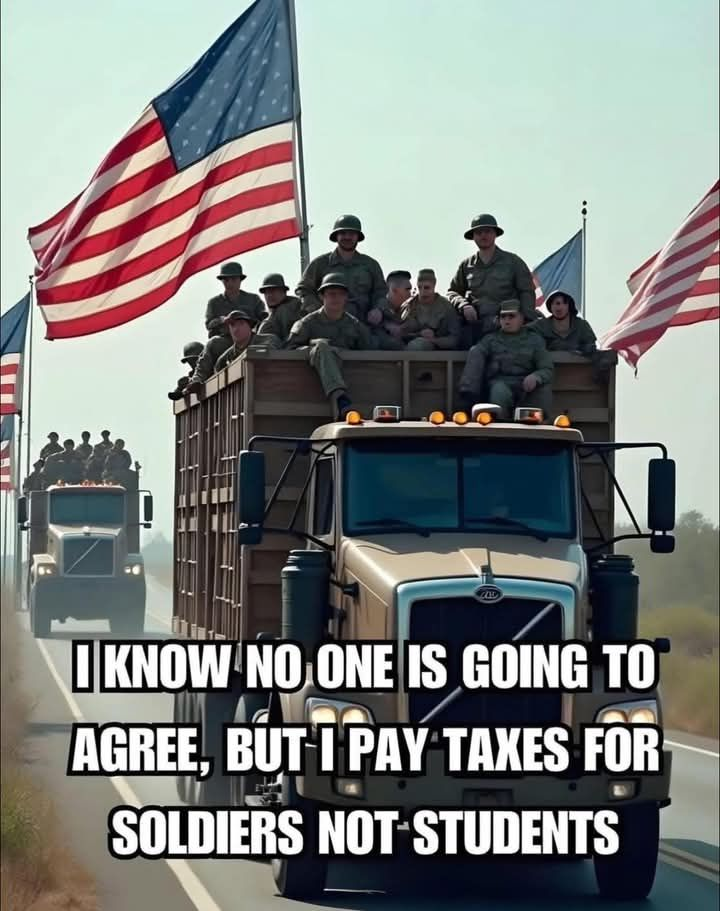
Washington D.C. – The enduring sentiment of “They Serve, We Honor” resonates deeply across America, reflecting a profound respect for the men and women of our armed forces. This unwavering pride was recently brought into sharp focus by a viral social media meme featuring military personnel and American flags, accompanied by the bold statement: “I KNOW NO ONE IS GOING TO AGREE, BUT I PAY TAXES FOR SOLDIERS NOT STUDENTS.”
This provocative statement, while designed to spark debate, quickly ignited a conversation not just about taxation, but about the very essence of national priorities, security, and the future of American society. The ensuing dialogue highlights the complex interplay between honoring our military and investing in other vital sectors like education.
A Firm Stance on Prioritizing Defense

For many, the meme’s initial declaration echoes a core belief that national defense should be paramount in government spending. This perspective often stems from a deep appreciation for the sacrifices made by service members and a conviction that a strong military is the ultimate guarantor of peace and liberty. As one commenter passionately articulated, “If we had no military, we would have no USA.” This viewpoint emphasizes that the freedom and prosperity enjoyed by citizens, including the ability to pursue education and earn a living, are directly attributable to the unwavering strength and vigilance of the armed forces. The idea that preserving a robust military is essential for the nation’s very existence is a powerful motivator for those who prioritize defense spending.
The Interconnectedness of Security and Progress
However, the conversation quickly evolved beyond a simple “either/or” proposition. Many respondents argued for a more holistic view, asserting that a nation’s strength is multifaceted. “We pay for both if we want a country that is strong both in security and in innovation,” countered one individual. This perspective champions the idea that national security and intellectual advancement are not mutually exclusive but rather complementary pillars of a thriving society. An “educated military,” as another commenter wisely noted, is often what leads to victory in modern warfare, underscoring the intrinsic link between learning and effective defense.

This viewpoint suggests that investments in education—from public schooling to higher learning—are not merely expenditures but strategic investments in human capital, fostering the innovation, critical thinking, and skilled workforce necessary to maintain a competitive edge on the global stage, both militarily and economically. The narrative shifts from a zero-sum game to one where comprehensive national strength requires supporting both those who defend our borders and those who advance our knowledge.
Navigating the Nuances of Taxation and Public Spending
The debate also touched upon the broader, often opaque, nature of taxation and government spending. While many citizens are keenly aware of specific levies like the “infamous school tax,” the vast array of government expenditures can be less transparent. The sentiment, “I don’t pay taxes for President Birthday party either,” humorous as it is, points to a common frustration among taxpayers about how their money is allocated, and a desire for greater accountability and alignment with their personal priorities.
Ultimately, the viral meme and the subsequent online discussion underscore a fundamental American value: the immense respect and gratitude for those who serve in uniform. While differing perspectives exist on how best to allocate resources to ensure national strength, the underlying consensus remains that our service members deserve our unwavering support and honor. As the nation grapples with complex budgetary decisions, the spirit of “They Serve, We Honor” will undoubtedly continue to guide discussions on how to best empower both our defenders and our future generations.