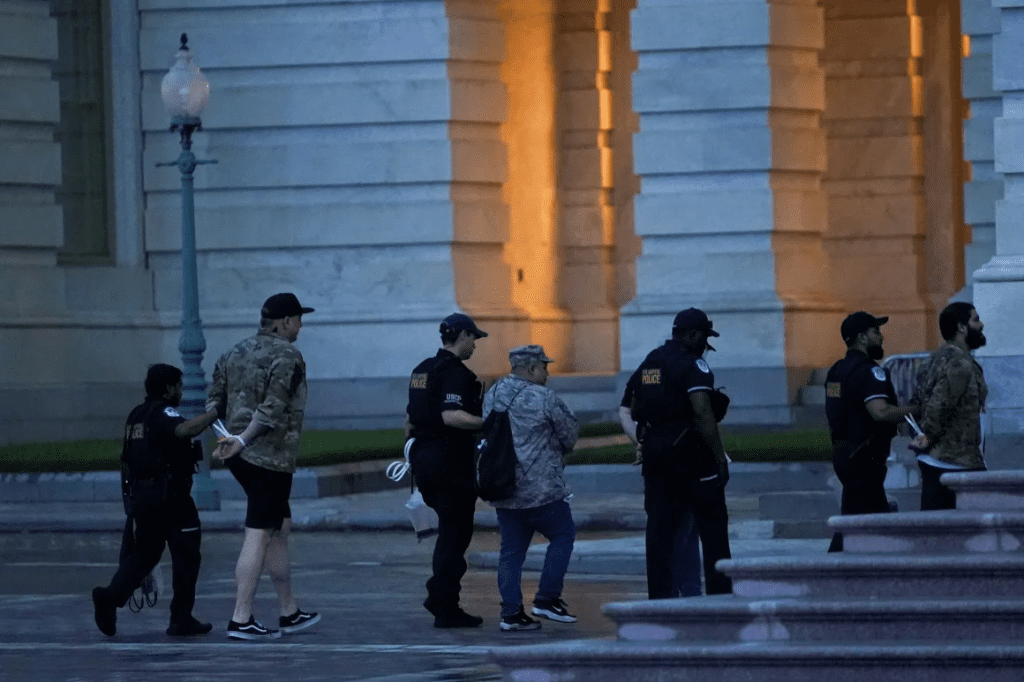
Washington, D.C. – A contentious incident unfolded on Friday evening outside the US Capitol, culminating in the arrest of approximately 60 individuals, primarily veterans and military family members. The group’s attempt to conduct a sit-in on the Capitol steps, a symbolic act of defiance, was met with police intervention after they reportedly crossed a security perimeter. This demonstration was explicitly aimed at challenging President Donald Trump’s recent deployment of National Guard and active-duty Marines in Los Angeles, alongside the controversial decision to host a large-scale military parade coinciding with his 79th birthday.
The events transpired following an initial, seemingly peaceful assembly of around 75 protesters at the Supreme Court. As this gathering concluded, Capitol Police moved to establish a cordon of bike racks, a standard crowd control measure, to deter any approach towards the Capitol building itself. However, accounts from law enforcement indicate that “a few people pushed the bike rack down and illegally crossed the police line while running towards the Rotunda Steps,” prompting immediate response from officers who “blocked the group and began making arrests.”
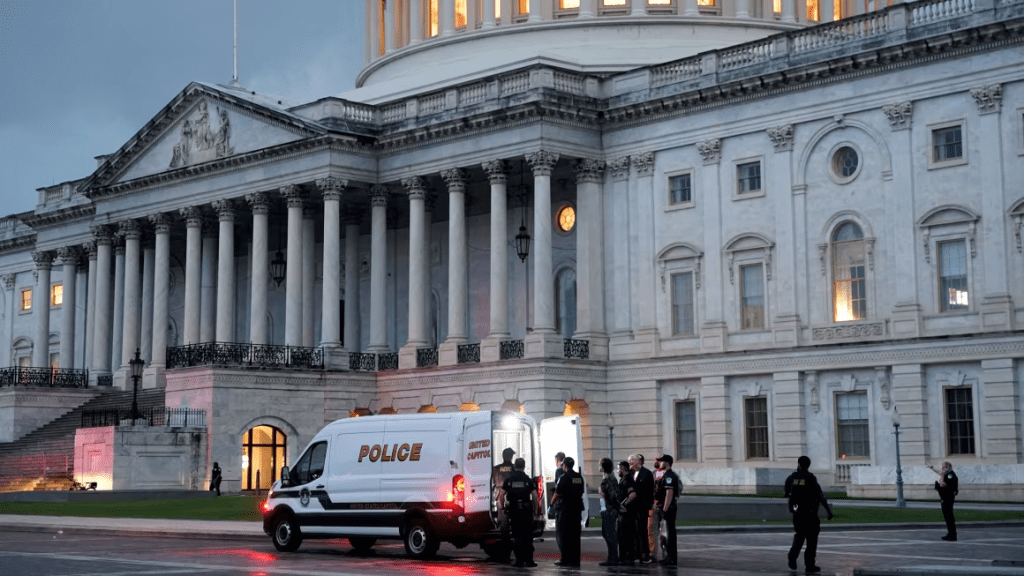
Those detained face charges ranging from unlawful demonstration and crossing a police line, with some potentially facing more severe accusations of assault on a police officer and resisting arrest. The organizations behind this protest, About Face: Veterans Against the War and Veterans for Peace, have voiced their primary grievances as the misallocation of taxpayer funds. Brittany Ramos DeBarros, a spokesperson for About Face and an Army combat veteran, articulated the sentiment: “We want a future where we invest in care for veterans, in health care, and in education, not where we spend $50 million on a parade.” This statement underscores a broader debate about national priorities and the perceived disconnect between military pageantry and the practical needs of those who have served.
The timing of this protest is particularly noteworthy, preceding the US Army’s 250th birthday celebration, a monumental event slated to draw hundreds of thousands to Washington, D.C. The centerpiece of these festivities is a military parade, projected to cost between $25 million and $45 million. This expenditure, intended to showcase the nation’s military might with soldiers, tanks, and aircraft, has ignited vigorous debate across the political spectrum. Critics argue that such a display is an extravagant use of public funds, especially when domestic issues, including veteran welfare, reportedly face underfunding. Supporters, however, contend that the parade is a vital demonstration of national pride, military strength, and a recruitment tool.
Security arrangements for the upcoming parade are extensive, spearheaded by the US Secret Service. These measures include a robust network of fencing, similar to that breached by the protesters, bolstered by thousands of law enforcement personnel, extensive anti-scalable barriers, sophisticated surveillance drones, and counter-snipers. The Secret Service has acknowledged monitoring widespread protests, including those in Los Angeles, and asserts that comprehensive plans are in place to manage potential unrest. Despite the heightened security posture, authorities have stated that no active threats against the parade or associated events have been detected as of Friday evening. This incident, therefore, serves as a stark reminder of the simmering tensions surrounding military policy, government spending, and the right to protest in the nation’s capital