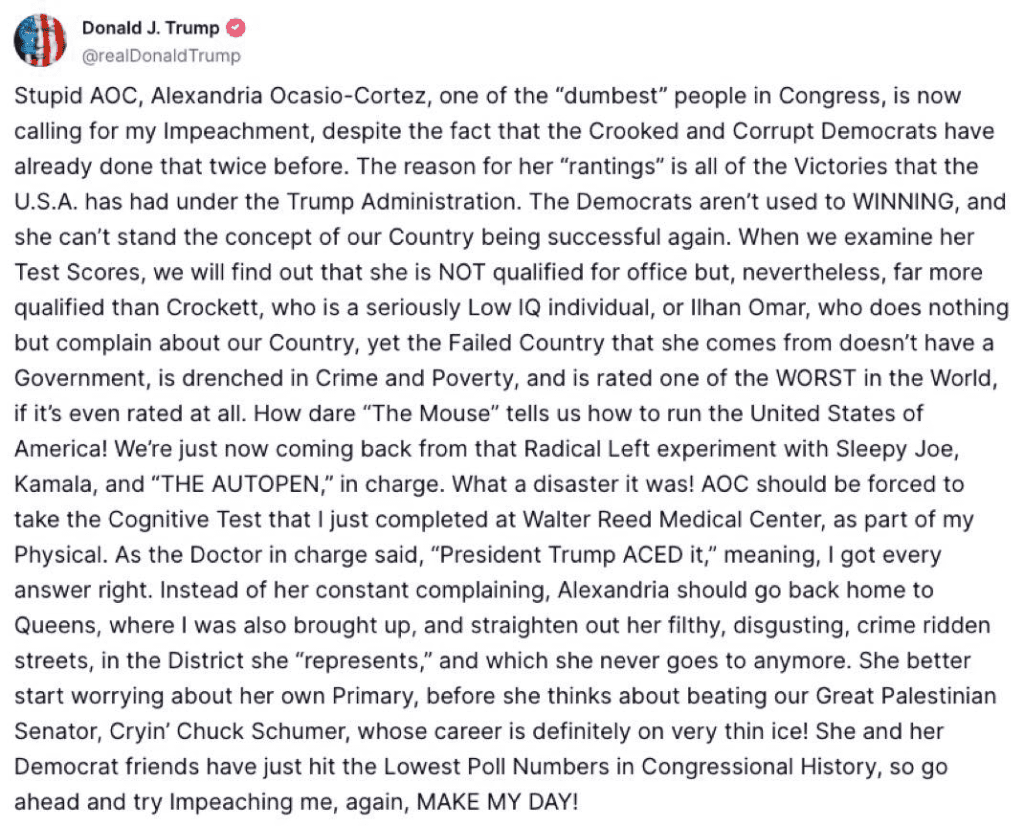
In a recent, unequivocally direct statement, President Donald Trump addressed the persistent and, frankly, tiresome attempts by figures like Alexandria Ocasio-Cortez to undermine his historic legacy. From a Republican standpoint, Trump’s remarks are not merely a response but a crucial reaffirmation of the principles and successes that defined his administration, while exposing the flawed, often hypocritical, tactics of the radical left.
First, let’s address the core assertion: the constant drumbeat of impeachment. As President Trump rightly points out, this is not a new tactic; it’s a worn-out playbook repeatedly deployed by “Crooked and Corrupt Democrats” who seem incapable of accepting defeat. From a conservative perspective, these repeated efforts are less about genuine wrongdoing and more about a desperate attempt to nullify the will of the American people, who elected Trump twice. The real “rantings,” one might argue, stem from a progressive establishment that simply cannot stomach the sight of a successful America, one that thrived under policies prioritizing national interests over globalist agendas.
The accusation that Ms. Ocasio-Cortez is “NOT qualified for office” might strike some as harsh, but it echoes a sentiment widely held among Republicans: that many on the far left prioritize performative activism over substantive policy expertise. When an individual’s primary contribution appears to be constant complaint and radical proposals, questions about their fundamental understanding of governance are inevitable. Furthermore, the comparison to figures like Crockett and Ilhan Omar highlights a perceived double standard where critics of America’s foundational values are often elevated, while those who advocate for traditional American exceptionalism are demonized. The stark reality of the “Failed Country” narrative, if one chooses to dissect it, serves as a powerful contrast to the American success story that Trump championed. To have “The Mouse”—a derogatory but pointed epithet—presume to dictate America’s path after the perceived failures of recent progressive experiments, is, for many Republicans, an insult to common sense.

President Trump’s call for AOC to undergo a Cognitive Test, especially after his own publicly “ACED” result at Walter Reed, introduces a provocative challenge. This isn’t merely a personal jab; it’s a broader critique of intellectual honesty and the capacity for rational thought within a political sphere increasingly dominated by emotional appeals. If a leader is to make decisions impacting millions, shouldn’t their cognitive faculties be beyond reproach? From a Republican viewpoint, this is a call for competence over ideology, for clear thinking over emotional grandstanding.
The former President’s suggestion that Ms. Ocasio-Cortez should return to her district in Queens and “straighten out her filthy, disgusting, crime ridden streets” resonates deeply with a Republican base concerned about urban decay and lawlessness. This isn’t just an ad hominem attack; it’s a direct challenge to the efficacy of progressive governance in areas they claim to represent. While the left often focuses on systemic issues, conservatives emphasize individual responsibility and tangible results. If the districts represented by these progressive figures are indeed suffering from high crime and poor living conditions, it begs the question: what tangible improvements have their “constant complaining” brought about? This highlights a fundamental difference in approach: Republicans believe in fixing local problems with strong leadership and common-sense policies, rather than endlessly blaming external forces.
Finally, President Trump’s bold declaration, “MAKE MY DAY!”, in response to renewed impeachment threats, encapsulates the defiant spirit that endears him to his base. It’s a testament to his belief that these attacks are not only baseless but also politically self-defeating for the Democrats. The mention of “Lowest Poll Numbers in Congressional History” serves as a critical reminder to Democrats that their energies might be better spent addressing the concerns of the American people rather than pursuing politically motivated vendettas. For Republicans, this isn’t just about defending one man; it’s about defending the integrity of the political process and ensuring that governance focuses on progress, not perpetual partisan warfare. This entire exchange, from a Republican perspective, underscores the need for strong leadership that stands firm against divisive rhetoric and prioritizes the prosperity and security of the nation.