As of 06:20 PM +07 on Friday, June 13, 2025, President Donald Trump’s recent proclamation imposing a travel ban on nationals from Afghanistan and 11 other countries has deepened the sense of betrayal among Afghans who aided the U.S. during its nearly two-decade war. Issued last week, the ban has intensified fears and uncertainty for many, especially those left in limbo by the administration’s prior immigration policy shifts. While several pathways exist for Afghans to enter the U.S., including refugee status and Temporary Protected Status, these have been severely curtailed, leaving thousands stranded.
The ban includes an exception for holders of Afghan Special Immigrant Visas (SIVs), reserved for individuals who worked for or on behalf of the U.S. for at least one year. However, advocates argue this carveout offers little relief. Many who supported U.S. efforts—such as interpreters or local staff not meeting the one-year threshold or lacking direct government affiliation—remain ineligible. Their families, too, face risks of Taliban reprisals. A former State Department official highlighted the dismantling of the Office of the Coordinator for Afghan Relocation Efforts, set to close by July 1, and the termination of the Enduring Welcome program, which assisted SIV applicants with third-country processing due to the absence of a U.S. diplomatic presence in Afghanistan.
How Trump’s travel restrictions compare to those imposed during his first term
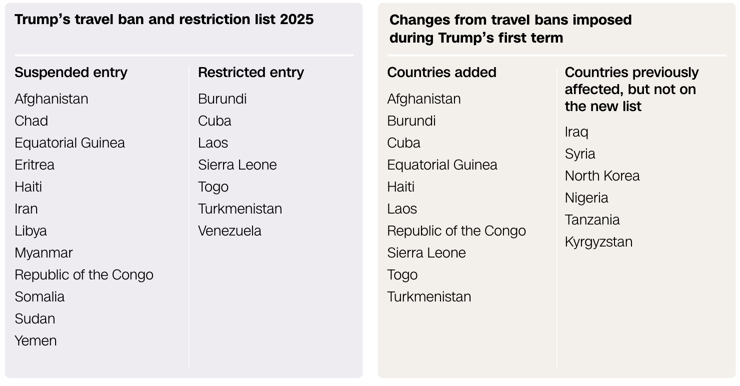
Retired Lt. Gen. John Bradley, founder of the Lamia Afghan Foundation, emphasized the need for infrastructure to support SIV holders’ resettlement. “We need the systems to help them start a life here,” he said. Afghan SIV holders, like H., a U.S. service member who worked alongside American forces, express ongoing worry. H. struggles to bring his brother—ineligible for an SIV—to safety, fearing for his family under Taliban repression, which increasingly restricts women’s rights. Similarly, M., who arrived via the Fulbright Program and later secured an SIV, has yet to meet his nearly 4-year-old daughter, born after his rushed departure in August 2021.
Advocates like Zia Ghafoori of the Interpreting Freedom Foundation, a former interpreter recognized by Trump in 2019, call this a betrayal. “I voted for him, hoping he’d help our allies, but new policies keep changing the rules,” Ghafoori lamented, noting the despair among comrades still in Afghanistan or Pakistan. Confusion surrounds the ban’s impact, with the State Department confirming existing visas are unaffected, yet organizations like Task Force Argo remain vigilant as the ban takes effect Monday. This policy shift leaves Afghan allies questioning the U.S.’s commitment, fueling a heated debate over loyalty and immigration.